

How To Enable Hyper V Platform In Windows 10
Windows x includes a number of improved features for Information technology, including updates to Hyper-V virtualization. In this article, I'll show you lot how you can install and configure Hyper-V in Windows 10.
- Author
- Recent Posts

Kyle Beckman works as a systems ambassador in Atlanta, GA supporting Role 365 in college instruction. He has 17+ years of systems administration experience.
Whether you lot need to run a different OS such every bit Linux, an old version of Windows, or a second (or third) re-create of the electric current Windows OS on your workstation, Hyper-Five on the desktop editions of Windows makes doing so very easy. Here'southward how to install Hyper-V on your Windows 10 computer.
Prerequisites ^
Hyper-V on Windows 10 has the following requirements:
- Machine running a 64-bit copy of Windows 10 Pro, Enterprise, or Instruction (sorry, the Dwelling edition isn't supported)
- Motherboard BIOS that supports hardware virtualization
- 64-fleck processor that supports Second Level Accost Translation (SLAT)
- Minimum 4GB RAM (however, you'll probably want 8GB at a blank minimum; all of my lab systems run with at to the lowest degree 16GB of RAM)
Configure hardware ^
Depending on the BIOS configuration that ships from your PC manufacturer, hardware virtualization support may come pre-enabled, or yous may demand to enable information technology in the BIOS yourself. Some OEMs enable it by default, some don't. Start the computer, enter the BIOS, and enable the hardware virtualization support. On my personal Lenovo ThinkPad, it was in Security, Virtualization, Intel (R) Virtualization Technology. The process can vary widely between manufacturers and models, so y'all may demand to consult the support site for your OEM to find the exact process.
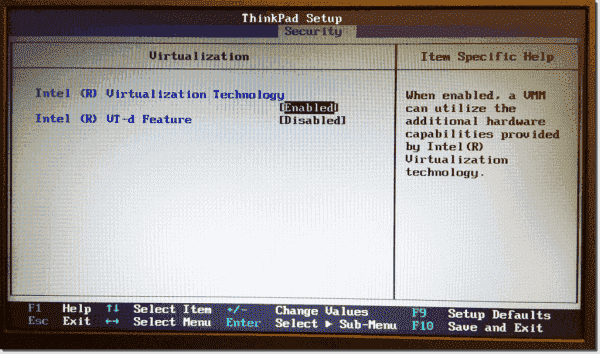
Enable Intel Virtualization Technology on a Lenovo ThinkPad
Install Hyper-V with the GUI ^
To install Hyper-V using the GUI, become to the Cortana search box and search for Plow Windows features on or off.
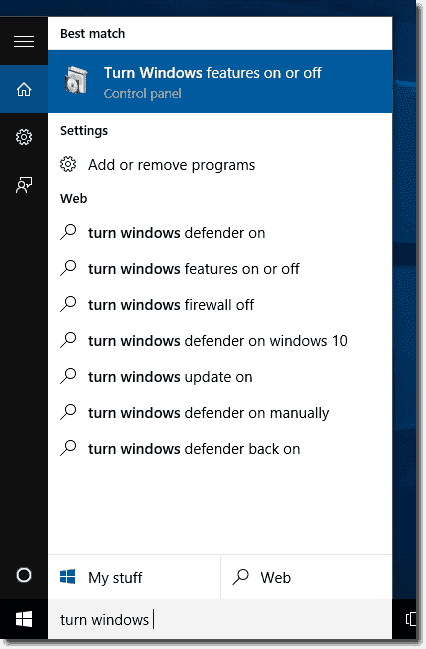
Turn Windows features on or off in the Cortana search box
Open the Plow Windows features on or off area of the Control Panel and gyre down to Hyper-Five. Select the top-level Hyper-Five check box and ensure that all the sub-features are selected. Click OK and then reboot.

Turning Hyper-V on
If the Hyper-5 Platform and Hyper-V Hypervisor features are grayed out, virtualization support may not exist enabled in the BIOS on your estimator. Reboot, enable virtualization support, and and then try the process once more.

Hyper-5 Hypervisor not bachelor in Turn Windows features on or off
Install Hyper-5 with PowerShell ^
To install Hyper-V in Windows x with PowerShell, run the following command with Admin rights:
Enable-WindowsOptionalFeature -Online -FeatureName Microsoft-Hyper-V -All
Hyper-Five volition be installed when you reboot.
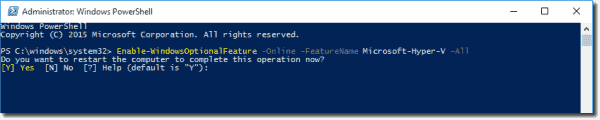
Enable Hyper-V in Windows x with PowerShell
Configure a virtual switch ^
For virtual machines in Hyper-V to access the network, yous'll demand to create a virtual switch. In near cases, you'll demand an external switch that allows the VMs to communicate with the host system, other VMs on the host, other systems on the network, and the Internet (assuming the host system has admission to the Internet).
To create a switch using PowerShell, open a PowerShell prompt with Admin rights and run the following control:
New-VMSwitch –Name "Virtual Switch" –NetAdapterName "Ethernet" –AllowManagementOS $true
Create an external switch in Hyper-V using PowerShell
This control creates a new switch named "Virtual Switch" that uses the wired Ethernet adapter and allows the host OS to use the adapter at the same time. (Notation: Y'all may need to adjust the NetAdapterName belongings depending on the name of your local network adapter.)
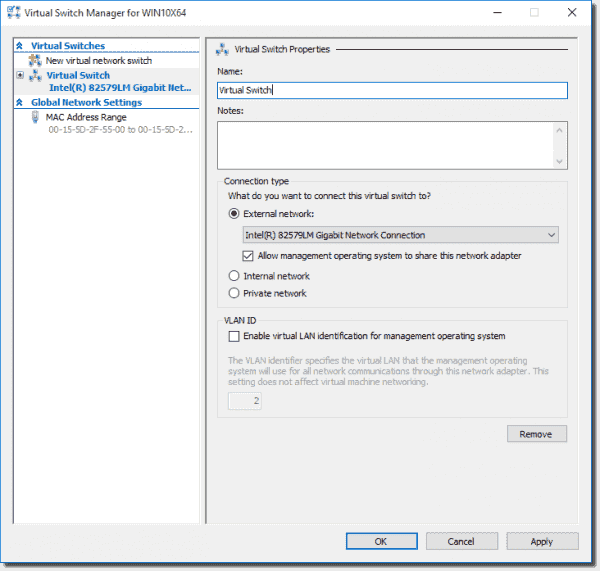
To create a virtual switch using the GUI, run Hyper-V Manager, click the host system, and go to Virtual Switch Manager. Y'all tin can access it in the Action pane on the right or past right-clicking the host system's proper name and choosing Virtual Switch Director.

Access the Virtual Switch Managing director in Hyper-V Director
In Virtual Switch Manager, go to New virtual network switch. Ensure External is selected and click Create Virtual Switch. Fix the proper noun of your new switch and select the network adapter in the pulldown in the External network department. (Ensure that the Allow management operating system to share this network adapter is selected.) Click OK to create the switch. (Alarm: This volition temporarily disrupt network connectivity on your computer.)
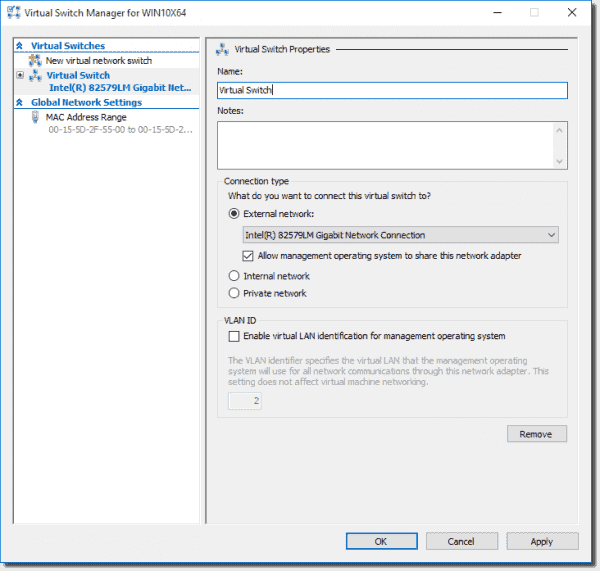
Create a new External virtual switch in Hyper-V on Windows ten
Other Hyper-5 configuration ^
One other change I typically like to make on my workstation running Hyper-V on Windows x is the storage location of the Virtual Hard Disks and Virtual Machines. Y'all tin can access the Hyper-V settings in Hyper-5 Manager by clicking Hyper-V Settings in the Actions pane or right-clicking the Hyper-V figurer name and choosing Hyper-5 Settings.
On the Hyper-V Settings window, you can update both Virtual Hard Disks and Virtual Machines to a new location of your choosing. My lab systems running Hyper-V always take a dedicated SSD disk for storing my VMs. This allows me to identify both the configuration files and the VHDX files on that dedicated deejay, for improved performance, instead of in the default locations. It as well makes finding the files much easier.
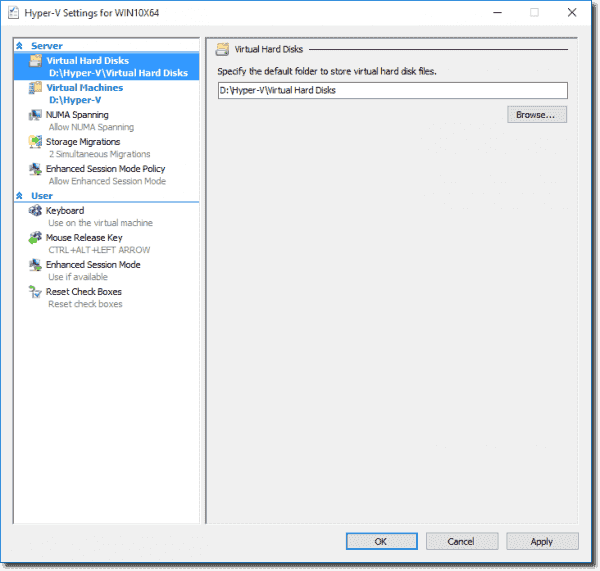
Changing the default storage location for Virtual Hard Disks and Virtual Machines
Configure antivirus ^
Windows Defender in Windows x doesn't automatically configure Microsoft's recommended antivirus exclusions later yous install Hyper-V. I've seen Hyper-V run just fine in Windows 10 without the recommended exclusions, but y'all're opening yourself up to potential problems if yous don't configure the antivirus.
Start by going to the Cortana search bar and search for Windows Defender settings. Scroll down to the Exclusions surface area and click Add an exclusion.

Windows Defender settings in Windows ten
Next, add the following exclusions:
Subscribe to 4sysops newsletter!
- C:\Windows\System32\vmms.exe: Virtual Machine Management Service
- C:\Windows\System32\vmwp.exe: VM Worker Process
- C:\ProgramData\Microsoft\Windows\Hyper-Five\: Default location for storing VM configuration files
- C:\Users\Public\Documents\Hyper-V\Virtual Hard Disks\: Default location for storing Virtual Hd files
- Custom location for storing VM configuration files
- Custom location for storing Virtual Hard disk files
- Any other folder containing a VHD, VHDX, AVHD, AVHDX, VHDS, VSV, and ISO files
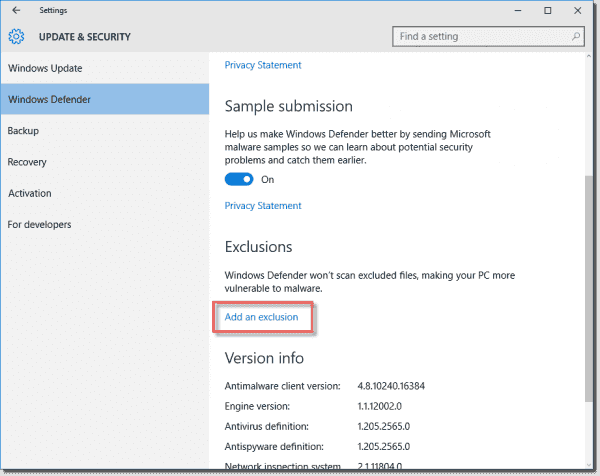
Windows Defender exclusions in Windows 10
Source: https://4sysops.com/archives/enable-and-configure-hyper-v-on-windows-10/
Posted by: mayerpromicame1979.blogspot.com
0 Response to "How To Enable Hyper V Platform In Windows 10"
Post a Comment